
Key Takeaways
- Cargo claim documentation begins at pickup, not at delivery. Condition notes and photos from loading are the baseline that supports or disputes a damage or shortage claim later.
- The bill of lading is the primary document in most cargo claims. Know what it says about cargo condition, weight, and liability limitations before signing it.
- Cargo claims are governed by freight contract terms, insurance policy language, and in interstate trucking, federal statute. The facts and documents matter, but so does the legal framework.
Related documentation steps
Claim evidence is easier to review when the photos, driver report, footage status, and supporting documents point back to one incident record.
documents needed after a truck accident · physical damage documentation · driver incident report checklist · responding to a demand letter
Documentation at pickup
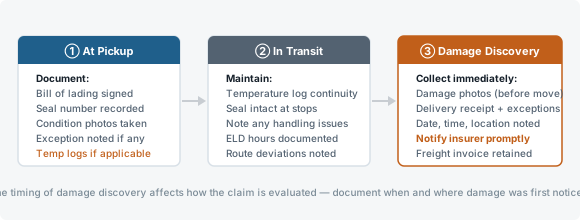
Note and photograph any pre-existing cargo damage before accepting the load. If a shipper presents cargo in questionable condition, note it on the bill of lading before signing. 'STC' (said to contain) or 'shipper load and count' notations don't protect the carrier the same way that a specific damage notation does.
Record the seal number if the load is sealed. Confirm the count or weight matches the bill of lading. When a count cannot be verified at pickup, note that explicitly. These details become the baseline for any shortage or damage claim filed at delivery.
During transit
If cargo shows signs of shifting, temperature change, or damage during transit, document it at the discovery point: date, time, location, photos, and driver observations. Note any road conditions, weather events, or unusual vehicle events — hard braking, impact — that occurred before the discovery.
Some cargo types have specific handling requirements that affect both the transit record and the claim analysis. If a temperature excursion occurred on a refrigerated load, retain the reefer unit's temperature log.
At delivery
If damage or shortage is discovered at delivery, document it before signing the delivery receipt. Photograph the damaged cargo, the container or trailer interior, and any broken or displaced securing equipment. Note the consignee's name and position if they are present at discovery.
A signed delivery receipt without notation of damage can limit the carrier's ability to dispute a later claim. If damage is discovered but the consignee won't wait for documentation, note the circumstances and preserve what evidence is available before the trailer is unloaded further.
After delivery
Retain the bill of lading, delivery receipt, weight tickets, seal records, and all photos in a single claim file. Notify your insurer or cargo claim contact promptly — many cargo policies have short notification windows that affect coverage.
Cargo claim outcomes depend on the freight contract, insurance policy terms, and the specific facts of the loss. Documentation establishes the facts. Whether a loss is covered, and for how much, is a separate question that the insurer, broker, or qualified professional addresses.
Core documents for a cargo claim
The following documents form the core evidence file for most cargo claims. Gaps in this list do not necessarily prevent a claim, but each missing item is a question the insurer will need to resolve some other way.
| Document | Purpose in the claim | When it's created |
|---|---|---|
| Bill of lading (signed copy) | Establishes cargo description, weight, and condition at pickup | At pickup |
| Pickup receipt / exception notation | Records any pre-existing damage or discrepancy at loading | At pickup |
| Seal record | Confirms seal number and intact status at departure and delivery | At pickup and delivery |
| Delivery receipt with exception notation | Records condition at delivery and any damage observed | At delivery |
| Condition photographs | Visual baseline at pickup; damage documentation at discovery | At pickup and at discovery |
| Temperature log (refrigerated loads) | Documents uninterrupted cold chain or identifies excursions | Throughout transit |
| Freight invoice | Establishes the value of the freight for settlement calculation | From shipper |
| Insurer notification record | Confirms timely notice per policy requirements | At discovery or delivery |
Retain all original documents — do not discard bills of lading or delivery receipts until the claim is fully resolved and closed.
Step-by-step checklist
- Collect the policy, unit number, driver details, and claim contact.
- Photograph damage, road conditions, cargo, documents, and scene markers.
- Keep repair estimates, tow records, bills of lading, and inspection notes.
- Document who received each file and when it was shared.
- Ask the insurer or qualified professional what else is required.
Evidence Handling
Preserve original files whenever possible. Record where each file came from, who handled it, and when it was shared.
Do not delete, modify, trim, or overwrite evidence because it seems unhelpful. Follow company policy, insurer instructions, and any legal hold process.
Insurance Boundary
This page is not insurance or claims advice. It cannot promise coverage, fault decisions, payment, or claim approval.
Coverage, deductibles, documentation requests, and deadlines depend on the policy, insurer, facts, and jurisdiction. Follow the claim contact's instructions and keep a copy of each submission.
Source Notes
- Driver's Handbook on Cargo SecurementFMCSA · official · last checked 2026-06-08Supports: cargo-documentation, cargo-condition, driver-safety
Supports general cargo condition and securement context. It is not cargo claim advice.
- How to File an Auto Insurance ClaimInsurance Information Institute · industry · last checked 2026-06-08Supports: insurance-claim-documentation, claim-communication
General insurance education reference. It is not carrier-specific claim advice and does not promise outcomes.
- Auto InsuranceNAIC · reference · last checked 2026-06-08Supports: insurance-basics, coverage-terms, deductible
General consumer insurance reference for terminology. Commercial trucking policies require separate review.
- 49 CFR 390.15: Assistance in Investigations and Accident RegistereCFR · official · last checked 2026-06-08Supports: accident-recordkeeping, incident-documentation, internal-review
Supports general accident register and recordkeeping context. Readers must check current rule text.
For source notes and related resources, visit https://www.crashprooftruck.com