
Key Takeaways
- This page provides general information about post-accident review structure. The review is most useful when it surfaces what the fleet can actually change — training gaps, equipment issues, policy weaknesses — rather than focusing only on driver fault.
- Post-accident drug and alcohol testing requirements depend on specific crash facts and current rules. Confirm whether testing applies through the appropriate company contact before assuming it does or doesn't.
- Internal review findings are sensitive. Route the documentation through appropriate contacts before sharing anything outside the company.
Related documentation steps
For a complete incident file, connect the scene notes to the photo record, witness details, and any dash cam preservation step that applies.
accident photo checklist · witness information checklist · dash cam preservation steps · what not to say at the scene
Before evaluating: preserve first
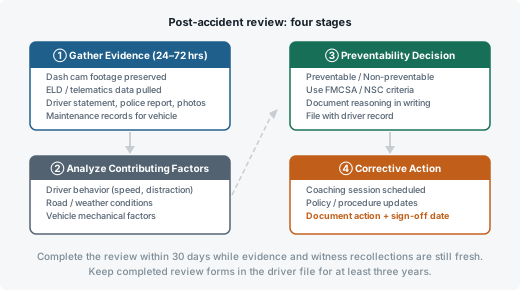
Before any analysis begins, confirm that available evidence has been secured: dash cam footage, ELD records, telematics data, maintenance records for the unit, the driver's incident report, witness contacts, and the police report number. Evidence preservation is time-sensitive — some systems overwrite event records on a rolling schedule.
Start preservation before evaluation. Reviewing an incident while evidence is still at risk of being overwritten is the wrong order.
Post-accident testing: confirm before acting
Whether post-accident drug and alcohol testing is required depends on specific facts — the nature of the crash, whether there was a fatality or an injury requiring immediate medical attention, whether the driver received a citation. The thresholds under 49 CFR 382.303 require careful factual application, not a general impression of how serious the incident was.
Time windows matter and are measured in hours, not days. Under the federal framework, alcohol testing must be initiated as soon as practicable; if not completed within 8 hours, the employer must document the reason and cease attempts.
Drug testing must be completed within 32 hours; if not done within that window, the employer must document why and stop pursuing it. Confirm the requirement through the safety contact as soon as crash facts are known — waiting can close the compliance window.
| Crash outcome | Federal testing trigger — general reference | What to do |
|---|---|---|
| Fatality | Testing required (citation not required) | Confirm alcohol and drug testing windows with safety contact |
| Bodily injury — person taken from scene for immediate medical care | Testing may apply depending on CDL/CMV factors | Confirm before assuming yes or no |
| Disabling damage requiring tow — driver cited | Testing may apply under specific conditions | Confirm using current 49 CFR 382.303 with safety contact |
| Property damage only, no injuries, no citation | Not triggered under federal rules | Verify whether company policy extends testing beyond federal requirements |
This table is a simplified reference only — not a compliance determination. Apply current 49 CFR 382.303 criteria to the specific facts of each incident through your safety or legal contact.
What the review should examine
Review the sequence of events as established by available evidence: what the driver reported, what camera and telematics data show, what the police report describes. Note where accounts are consistent and where gaps or discrepancies exist.
Examine contributing factors beyond driver behavior: road conditions, equipment condition at the time, cargo loading, route complexity, and prior incident history for the driver or the unit. A review that focuses only on driver error and ignores systemic factors produces narrower findings than one that looks at the full picture.
Documentation and protecting the findings
Document the review: what happened based on available evidence, what contributing factors were identified, what corrective actions are planned with specific owners and due dates. If the company makes a preventability determination, document the basis separately from the corrective action plan.
Treat review findings as internal documents. Preventability determinations, identified training gaps, and planned corrective actions are sensitive in a litigation context. Any request for review materials from outside the company should go through the appropriate legal or safety contact — not through normal operations.
Step-by-step checklist
- Check for injuries and call emergency services when needed.
- Move only when it is safe and lawful to do so.
- Collect driver, carrier, vehicle, witness, police, cargo, and insurance details.
- Take wide, medium, and close photos before conditions change.
- Preserve notes, photos, video, and documents under company policy.
Evidence Handling
Preserve original files whenever possible. Record where each file came from, who handled it, and when it was shared.
Do not delete, modify, trim, or overwrite evidence because it seems unhelpful. Follow company policy, insurer instructions, and any legal hold process.
Legal Boundary
This is general information only. It is not legal advice and does not tell you how to handle a claim, lawsuit, investigation, subpoena, legal hold, or evidence dispute.
Rules and duties can vary by jurisdiction, company policy, contract, and facts. Ask a qualified professional when a decision could affect a driver, claim, or case.
Source Notes
- 49 CFR 390.15: Assistance in Investigations and Accident RegistereCFR · official · last checked 2026-06-08Supports: accident-recordkeeping, incident-documentation, internal-review
Supports general accident register and recordkeeping context. Readers must check current rule text.
- What Tests Are Required and When Does Testing Occur?FMCSA · official · last checked 2026-06-08Supports: post-accident-testing, driver-policy
High-level official guidance for testing categories. This site does not provide compliance decisions.
- 49 CFR 382.303: Post-Accident TestingeCFR · official · last checked 2026-06-08Supports: post-accident-testing, regulated-testing
Primary rule-text reference for post-accident testing. Pages use cautious wording and direct readers to current rules.
- Drug and Alcohol Testing ProgramFMCSA · official · last checked 2026-06-08Supports: drug-alcohol-program, driver-policy
Background reference for CDL drug and alcohol testing program requirements.
- Crash Preventability Determination ProgramFMCSA · official · last checked 2026-06-08Supports: crash-review, internal-review, preventability
Used for broad crash review context. Pages avoid telling readers how an individual crash will be classified.
For source notes and related resources, visit https://www.crashprooftruck.com