
Regulatory Status
Proposed rulemaking (NPRM) — not a final rule
Heavy vehicle AEB is addressed under a separate proposed rule from NHTSA and FMCSA. Check current NHTSA, FMCSA, and Federal Register materials before making compliance decisions. The light vehicle final rule is a different rule and does not apply to heavy trucks.
Last verified: 2026-06-08
Key Takeaways
- The heavy vehicle AEB rulemaking is separate from the NHTSA final rule for light vehicles — consult current NHTSA and FMCSA materials before drawing compliance conclusions.
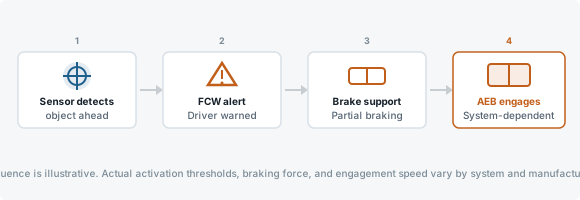
- AEB may warn, support braking, or apply braking depending on system design, speed, and conditions. It does not replace driver judgment, following distance, or pre-trip inspections.
- Document which AEB system is installed on each unit, what training drivers received, and any manufacturer service or software notices retained in the unit file.
Related documentation steps
Technology pages should be read with the unit file, driver training record, and event data source in mind, not as a substitute for the full incident review.
ADAS feature differences · telematics and reconstruction · ELD accident documentation
Current regulatory status
Heavy vehicle AEB in the United States should be described as a rulemaking topic unless a later final rule is confirmed from official sources. NHTSA and FMCSA issued a notice of proposed rulemaking for heavy vehicles, while NHTSA finalized a separate AEB rule for light vehicles.
This is not a final heavy truck mandate. Do not treat the light vehicle final rule as a heavy vehicle final rule. Fleets should check current NHTSA, FMCSA, and Federal Register materials before making compliance decisions.
| Light vehicles | Heavy vehicles (commercial trucks) | |
|---|---|---|
| Rule status | Final rule — FMVSS No. 127 | Proposed rulemaking (NPRM) |
| Mandate for new vehicles | Phased in 2026–2029 | Not yet mandated |
| Applies to | Passenger cars and light trucks | Tractor-trailers and heavy commercial vehicles |
| Primary reference | NHTSA.gov / FMVSS 127 | NHTSA.gov and FMCSA.dot.gov |
Verify current rule status at NHTSA.gov and FMCSA.dot.gov before making compliance decisions.
What AEB can and cannot do
AEB systems may warn, support braking, or apply braking when sensors detect a crash-imminent situation. Performance depends on system design, maintenance, weather, speed, object detection, and driver behavior.
AEB is a safety layer. It does not replace following distance, pre-trip checks, driver training, or post-incident documentation.
Questions to answer for each unit
Do not record only that a truck has AEB. Record the system name, model year, software or calibration notes if available, whether forward collision warning is separate from braking support, and whether the driver received unit-specific training.
Mixed fleets need this detail. A 2019 tractor with a warning-only system and a newer tractor with braking support can both be described casually as AEB-equipped, but they behave differently in a review.
Fleet documentation points
Record equipment specifications, driver training, maintenance notes, software notices when applicable, and event data retained under company policy.
After an incident, preserve available camera, telematics, ELD, maintenance, and driver statement records through the normal evidence process.
Common review mistakes
Do not assume the absence of an AEB alert means the system failed. Road grade, vehicle speed, object type, sensor blockage, weather, and system design can all affect whether a warning or braking event is generated.
Do not assume the presence of an alert proves the driver ignored it. Pair system logs with forward video, driver statement, ELD records, telematics speed, maintenance records, and the known limits of that system.
Step-by-step checklist
- Confirm the system installed on the specific unit.
- Document driver training and known system limitations.
- Retain alerts, camera clips, ELD records, and maintenance notes when relevant.
- Review safety events consistently instead of only after severe crashes.
- Use technology as support for safety decisions, not as a substitute for judgment.
Safety Boundary
General information only. This is not safety consulting, regulatory compliance advice, or a substitute for current official requirements and company policy.
Source Notes
- NHTSA and FMCSA Propose AEB Requirement for Heavy VehiclesNHTSA · official · last checked 2026-06-08Supports: heavy-vehicle-aeb, proposed-rule, safety-technology
Official announcement of proposed heavy vehicle AEB rulemaking. It does not make the proposal a final heavy truck mandate.
- Heavy Vehicle Automatic Emergency Braking; AEB Test DevicesFMCSA / Federal Register · official · last checked 2026-06-08Supports: heavy-vehicle-aeb, nprm, rulemaking-status
Federal Register NPRM entry for heavy vehicle AEB. Pages must describe this as rulemaking, not a final heavy truck mandate.
- Heavy Vehicle Automatic Emergency Braking; AEB Test DevicesFederal Register · official · last checked 2026-06-08Supports: heavy-vehicle-aeb, nprm, official-notice
Primary Federal Register version of the heavy vehicle AEB NPRM.
- NHTSA Finalizes Rule on Automatic Emergency BrakingNHTSA · official · last checked 2026-06-08Supports: light-vehicle-aeb, final-rule, rulemaking-distinction
Light vehicle final rule background. It must be separated from heavy vehicle AEB rulemaking.
- Driver Assistance TechnologiesNHTSA · official · last checked 2026-06-08Supports: adas, driver-assistance, technology-limitations
General background for ADAS terms, warnings, and technology limitations.
For source notes and related resources, visit https://www.crashprooftruck.com