
Key Takeaways
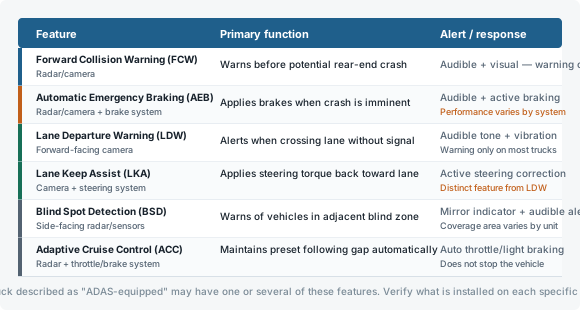
- ADAS is a label for several distinct features — forward collision warning, AEB, lane departure, blind spot detection, adaptive cruise — each with different sensors, coverage, and limitations.
- Know what is actually installed on each unit, not just whether the truck is described as 'ADAS-equipped.' A truck can have one feature and not another.
- Driver orientation records should reflect the specific systems on the trucks each driver operates, not a general acknowledgment of ADAS technology.
Related documentation steps
Technology pages should be read with the unit file, driver training record, and event data source in mind, not as a substitute for the full incident review.
ADAS feature differences · telematics and reconstruction · ELD accident documentation
What ADAS includes — and what it doesn't
Advanced driver assistance systems group several distinct technologies under one label: forward collision warning, automatic emergency braking, lane departure warning, blind spot detection, adaptive cruise control, and others. These features are not interchangeable.
A truck with lane departure warning does not necessarily have AEB, and a truck with AEB may have a different detection range or braking threshold than a newer model from the same manufacturer.
The distinction matters in incident review. When an insurer or investigator asks what safety systems were active, 'ADAS-equipped' is not a sufficient answer. The specific feature, system version, and configuration on that unit on that day is what counts.
How these features behave on large trucks
Radar and camera sensors on commercial trucks face conditions that differ from the passenger vehicle environments where many of these technologies were originally tested. Wide load widths, longer stopping distances under load, frequent lane changes near construction zones, and variable mirror configurations all affect how sensors read the road ahead.
Automatic emergency braking may be calibrated for higher speed thresholds on heavy vehicles than on passenger cars. Lane departure warning may not respond consistently in a construction zone where markings are painted over or partially removed. Knowing the operating conditions each system is designed to handle — and which conditions degrade its performance — is part of what driver training should cover.
Fleet documentation before an incident
Keep a record of the installed ADAS features and system versions for each unit. Retain any manufacturer alerts, recall notices, or fleet service bulletins related to safety systems. If a software update changes system behavior, note it in the unit file.
Driver orientation records should show that each driver was trained on the systems equipped on the trucks they operate. A blanket 'ADAS training completed' acknowledgment doesn't reflect meaningful differences between units in a mixed fleet.
After an incident involving an ADAS-equipped truck
Preserve any alert or event log data from the ADAS system alongside camera footage, ELD records, and maintenance files. Some ADAS systems generate event records separate from the fleet telematics platform. Ask the system vendor or fleet manager what data that specific system captures and where it is stored.
Route all data requests from insurers, investigators, or attorneys through the company safety contact. Do not delete, overwrite, or reset system event memory while the incident documentation window is open.
Step-by-step checklist
- Confirm the system installed on the specific unit.
- Document driver training and known system limitations.
- Retain alerts, camera clips, ELD records, and maintenance notes when relevant.
- Review safety events consistently instead of only after severe crashes.
- Use technology as support for safety decisions, not as a substitute for judgment.
Safety Boundary
General information only. This is not safety consulting, regulatory compliance advice, or a substitute for current official requirements and company policy.
Source Notes
- Driver Assistance TechnologiesNHTSA · official · last checked 2026-06-08Supports: adas, driver-assistance, technology-limitations
General background for ADAS terms, warnings, and technology limitations.
- National Roadway Safety StrategyU.S. DOT · official · last checked 2026-06-08Supports: roadway-safety, safety-system
General roadway safety-system context for technology and policy pages.
- Crash Avoidance FeaturesIIHS · industry · last checked 2026-06-08Supports: crash-avoidance, adas, technology-limitations
General reference for crash avoidance technology explanations.
- 49 CFR Part 563: Event Data RecorderseCFR · official · last checked 2026-06-08Supports: event-data, accident-reconstruction, technology-records
Reference for event data recorder context. Pages avoid implying all commercial trucks have identical data systems.
For source notes and related resources, visit https://www.crashprooftruck.com